In a world that often feels increasingly divided, Freemasonry offers something remarkably simple: a place for men to find fraternity, purpose, personal growth and meaningful connection.
There are times when the world feels unusually difficult to understand.
We are surrounded by information, yet it can be difficult to know what to believe. We are constantly connected, yet many people feel increasingly isolated. Political and social divisions seem to find their way into almost every conversation, while disagreement too easily becomes hostility. Technology allows us to communicate instantly with people anywhere in the world, but meaningful conversation and genuine friendship can sometimes seem harder to find.
If you have felt any of this, you are certainly not alone.
Perhaps you have also reached a point in life when you find yourself looking for something more. Not necessarily something dramatic, but something meaningful: better friendships, a stronger sense of purpose, opportunities to learn, a way to contribute to your community, or simply a place where you can spend time with good people who are also trying to become better versions of themselves.
For centuries, Freemasonry has provided such a place.
At its heart, Freemasonry is built around a very old idea: before we can expect to improve the world around us, we should first be willing to work on ourselves.
The Ancient Language of the Builder
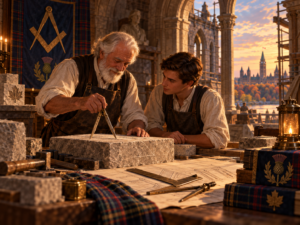
The symbolism of Freemasonry comes from the traditions of the builders and stonemasons who constructed the great structures of Europe centuries ago. An apprentice learned his craft gradually. He worked beside more experienced men, learned the proper use of his tools, developed discipline and judgment, and eventually became capable of helping others learn.
Modern Freemasonry transformed that tradition into a philosophy of personal development.
The stone being shaped became the individual himself.
The tools of the builder became reminders of integrity, fairness, self-control, education and responsibility toward others. The Lodge became a place where men could learn from one another and where experience could be passed from one generation to the next.
The objective was no longer to construct a cathedral of stone. It was to build character.
That idea remains remarkably relevant.
Freemasonry does not expect a man to arrive at its doors having everything figured out. In fact, the Masonic journey begins with the opposite assumption. Every one of us is unfinished. We have strengths, but also weaknesses. We possess knowledge, but there is much we do not know. We have opinions that sometimes deserve to be challenged and habits that sometimes deserve to change.
The question is not whether we are perfect.
The question is whether we are willing to grow.
A Place to Learn, Listen and Grow
A Mason begins his journey as an Entered Apprentice, and there is wisdom in that title. An apprentice is expected to listen, observe and learn.
As he progresses, he is encouraged to develop his mind as well as his character. Education and curiosity have always occupied an important place in Freemasonry. A man should remain teachable throughout his life, capable of reconsidering his assumptions, learning from others and recognizing that knowledge without humility has little value.
Eventually, he becomes a Master Mason. Despite the title, this does not mean that the work is complete. Quite the opposite. The lessons increasingly turn toward responsibility, service, mortality and the importance of using our limited time wisely.
A Mason gradually discovers that personal growth has no final graduation ceremony.
There is always something more to learn and another opportunity to serve.
That journey is undertaken in the company of other men.
And perhaps that is where Freemasonry has something particularly important to offer today.
You Do Not Have to Think Alike to Be Brothers
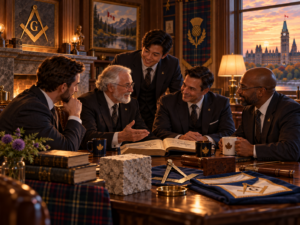
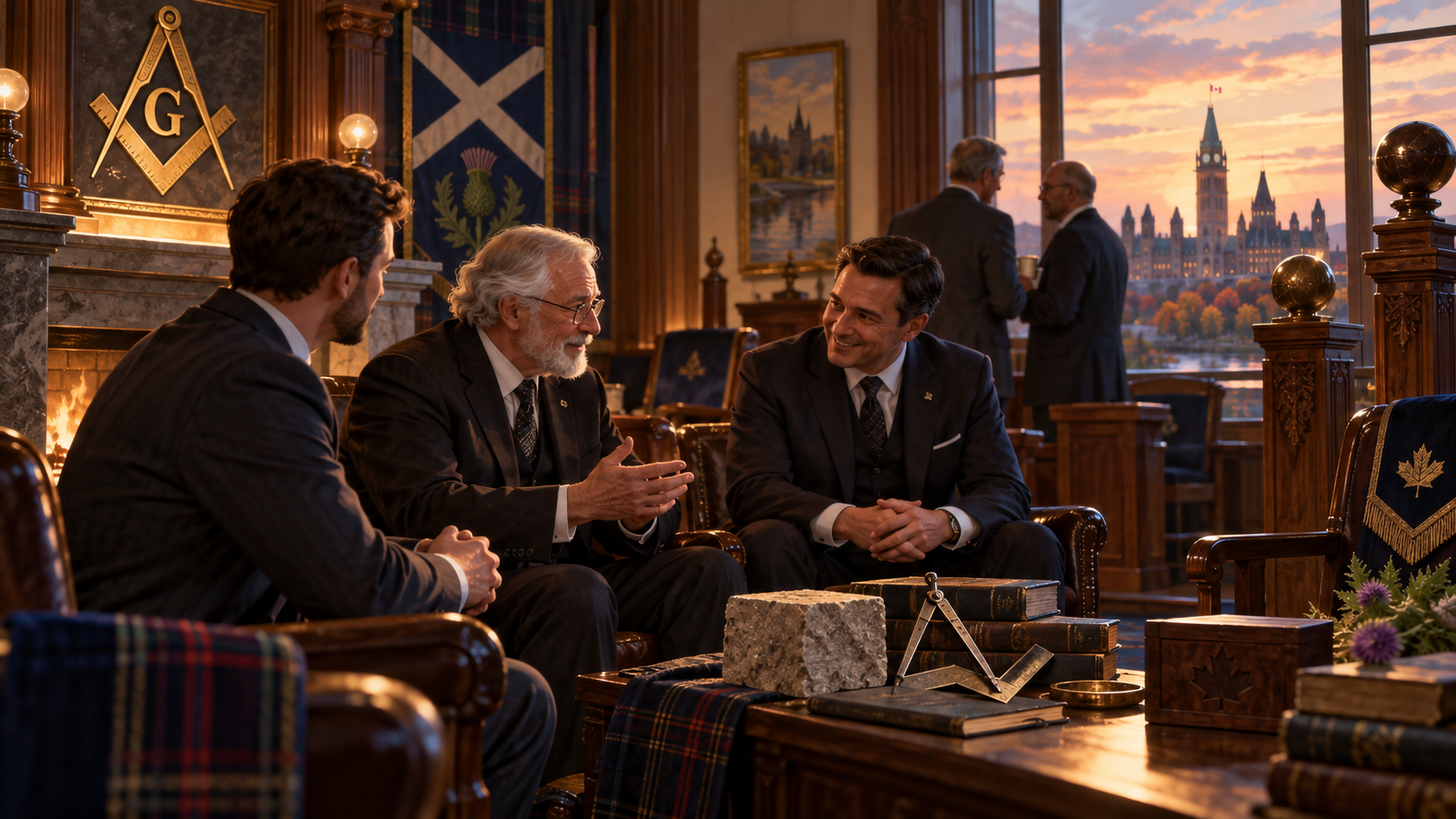
Walk into a Masonic Lodge and you may find men of very different ages, occupations, backgrounds and experiences sitting beside one another.
There may be professionals and tradesmen, young men beginning their careers and retirees with decades of experience. They may hold very different political opinions. Their religious traditions may differ. Outside the Lodge, society may place them in completely different categories.
Inside the Lodge, they call one another Brother.
Freemasonry does not require men to think alike. Instead, it asks something considerably more difficult: that men who are different learn to respect one another.
This is one reason partisan political and sectarian religious arguments are traditionally kept outside the Lodge room. A Masonic Lodge is not intended to become another battlefield in the divisions of the outside world.
It provides something increasingly uncommon: a space where men can meet one another as human beings first.
That does not mean avoiding difficult ideas or surrounding ourselves only with people who agree with us. It means learning how to disagree without becoming enemies, how to listen without immediately preparing a response, and how to value another person without requiring him to become a copy of ourselves.
In a deeply polarized world, there is considerable value in simply practising fraternity.
Brotherhood Is More Than a Word
Masonic brotherhood is not limited to ceremonies or formal meetings.
It is found in ordinary moments.
It is a younger Mason receiving guidance from someone with decades more experience. It is Brethren helping one another prepare for a ceremony, organizing a charitable activity, sharing a meal, visiting someone who is ill or quietly supporting a Brother going through a difficult period.
It is also the conversation after the meeting, when men with different lives simply sit together and talk.
Friendship between generations has become surprisingly uncommon in modern society. Freemasonry deliberately creates opportunities for it.
A man in his thirties may develop a friendship with someone in his seventies. One may possess energy and new ideas; the other may possess perspective acquired over decades. Both have something to contribute and something to learn.
Over time, the relationship changes. The man who once needed guidance becomes the person offering it to someone else.
That is how a Lodge continues from generation to generation.
An Old Institution for a Modern Problem
Freemasonry has survived extraordinary periods of history because the human problems it addresses have never disappeared.
Masons have lived through revolutions, wars, dictatorships and enormous social transformations. Freemasonry itself was suppressed by authoritarian governments, including Nazi Germany and Francoist Spain, precisely during periods when freedom of conscience and voluntary association were under attack.
The Craft has crossed paths with some of the great turning points of modern history. In Canada, Sir John A. Macdonald, the country’s first prime minister and one of the Fathers of Confederation, was a Freemason, as were figures such as Sir Sandford Fleming, Tommy Douglas and John Diefenbaker. In the United States, George Washington and Benjamin Franklin were prominent Freemasons during the creation of the new republic. Across Europe, Giuseppe Garibaldi became one of the great figures of Italian unification, while Freemasons such as Lafayette and Georges Danton were prominent during the revolutionary transformation of France. Across Latin America, Masonic and Masonic-inspired networks became associated with struggles for independence, constitutional government and civic liberty.
Freemasonry cannot claim the achievements of these individuals, nor should history be simplified into a list of famous Masons. What their stories demonstrate is something broader: for generations, Lodges have brought together men interested in learning, service, civic responsibility and the improvement of both themselves and their communities.
The world has changed enormously since those men entered their Lodges.
Human nature has changed considerably less.
We still struggle with anger, pride, prejudice and uncertainty. We still search for friendship and meaning. We still wonder whether we are using our time well and whether our lives are contributing something beyond ourselves.
That is why the old tools still have something to teach us.
Who Are You Becoming?
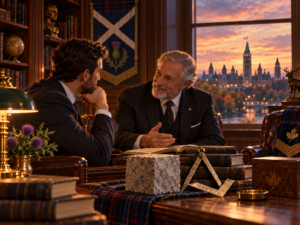
Perhaps the most important question Freemasonry asks a man is not what he has accomplished, what position he holds or how much he owns.
It is much simpler:
Who are you becoming?
Character is being formed whether we consciously work on it or not. Our repeated choices become habits, our habits influence our character, and our character affects our families, friendships, workplaces and communities.
Freemasonry encourages a man to make that process deliberate.
It offers structure without demanding conformity. It offers tradition without requiring a man to stop asking questions. It offers leadership while reminding every leader that his time in the chair will eventually end. It offers opportunities for service while teaching that some of the most important acts of charity will never be publicly recognized.
Above all, it reminds us that becoming a better man is not an individual pursuit undertaken in isolation.
We need other people.
We need mentors.
We need friends who will encourage us but who will also challenge us.
We need people with whom we can laugh, learn, work and occasionally disagree.
We need community.
Finding That Community at St. Andrew’s
At St. Andrew’s Lodge No. 560 in Ottawa, we are part of this centuries-old tradition, but our Lodge is very much a community of men living in the present.
We come from different backgrounds and generations. We have different professions, experiences and perspectives. What brings us together is not that we agree about everything. It is a shared belief that fraternity, personal growth, education, service and good character still matter.
We believe there is value in preserving traditions while continuing to learn. We believe there is value in mentorship and in giving men opportunities to develop confidence and leadership. We believe there is value in sitting around a table together, speaking face to face and discovering friendship in a world where so many relationships have become temporary or digital.
And we believe that nobody completes this work alone.
Perhaps you have been looking for something similar without having a name for it.
Perhaps you have reached a stage in your life where professional success alone is no longer enough. Perhaps you would like to contribute more to your community. Perhaps you miss the kind of friendships in which people actually make time for one another. Perhaps you enjoy learning and would like to meet others who still believe that curiosity, character and thoughtful conversation matter.
Or perhaps the noise and division of the last few years have simply made you wonder whether there are still places where people with different perspectives can meet, respect one another and build something together.
There are.
Freemasonry is one of them.
It is not for every man, and it does not promise to have every answer. What it offers is a journey, a community and a set of tools that generations of men have used to examine their lives and try to leave something worthwhile behind.
The old builders understood that great structures are not created all at once. They are built stone by stone, patiently, with each generation adding something to the work begun by those before them.
People are much the same.
So are communities.
There will always be rough stones to shape, lessons to learn, friendships to build and work worth doing.
And when the world around us sometimes feels uncertain, divided or simply a little darker than we would like, there is something reassuring in knowing that we do not have to build alone.
If this way of looking at life speaks to you, perhaps it is worth getting to know us.
This article is adapted from our longer feature, “When the World Grows Dark, We Build: The Enduring Value of Freemasonry.” [Read the full article]